Capers
I post a lot of food pics and updates on my personal facebook page that I don't share here. At least that's been my habit up to now. Most of those posts are more informal and certainly briefer than the content I'm used to submitting on the blog. But I suppose if people wanted to see those images along with a bit lengthier supporting text, reproduced here on the blog, I could do that. Let me know what you think (either here or via facebook).
Yesterday made a facebook status update with an image of some bruschetta (left) that I made with limited ingredients we had in the house at the time, including capers. The update sparked some conversation on the merits and edibility of capers. One of my friends described them as tasting "like pickled, salty, raisins. Gross." That got me thinking, because while I enjoy capers now, my initial reaction to them years ago was much the same as that of my friend. Repeated sampling over the years has given me a greater appreciation for the little unopened flower buds, and I now find them indispensable as an ingredient in a number of recipes and dishes. My relationship with capers has followed a path similar to the one I had with anchovies, which I initially disliked rather intensely but now see as a requisite pantry staple.
Wikipedia has a brief, though solid entry on capers, on their biology, environmental requirements, propagation, history and culinary uses: http://en.wikipedia.org/wiki/Caper. Capers have been used for thousands of years, with a few notable ancient Greeks giving the plant due attention, and with allusions to its alleged aphrodisiac qualities also noted by the ancient Hebrews. Interesting stuff, this history of food.
Four different capers from the pantry.
I use capers in pasta dishes, some sauces, bruschetta toppings and other tapas, and of course with fish like salmon, which is a traditional pairing. They offer a nice tart, acidic element to oily fish or rich sauces, as well as a counterbalance of sorts in salads that have strong citrusy or even fruity profiles. If you've tried capers and were initially turned off by them, I'd suggest you not give up yet. Try different varieties and brands (the preserving brine has a lot to do with the flavor, and there are of course as many different brine recipes out there as there are for any other pickled vegetable). Find recipes you like where capers are a key ingredient, and make the recipe with and without their addition to learn what they may contribute.
Capers come in different sizes, with nonpareilies being, I believe, the smallest, most common and most desirable. I've included a couple images of different capers I have in the fridge, including some nasturtium capers I made myself from the seeds of the peppery flowers we grow in our garden. In the image above, from left to right, we have a small group of capers followed by seemingly identical capers from an unknown terroir. The first little bunch were packaged in a small jar, not quite 4 oz worth, and have a very nice, mellow and slightly lemony flavor. The second bunch came from a large, 16 oz. jar I purchased at Whole Foods, and their flavor is quite salty, briney and closer to cheap green olives (or to the description my facebook friend gave capers in general). Both jars were also pretty close in price as I recall. You get what you pay for I suppose.
Next on the plate are caper berries. Capers are the unopened flower buds of the caper plant. If the buds are not picked for use as capers, but are left alone, they will eventually become flowers, which in turn will become a seed-filled caper fruit, or "berry". These caper berries are then picked and processed in much the same way as regular capers. They do, however, have a rather different flavor and texture than their softer predecessors. Caper berries are crunchy. They're filled with crunchy little seeds, and the ones that I've tried have had more of a slightly peppery, citrusy, pickled olive flavor. my favorite way to use caper berries is as a Bloody Mary or Martini garnish. They're perfect for that.
l-r: capers, caperberries, nasturtium capers
Finally, on the far right of the plate, are the pickled nasturtium seeds. These pea-sized seeds make quite an interesting substitute caper. They have an intriguing flavor profile that combines the slight peppery bite of nasturtiums with the sweetness of the sugared brine I made, and a potent, unmistakable flavor of sweet cream butter. I never would have imagined that I'd get the flavor of fresh butter from pickled nasturtium seeds, but it's there in force. Amazing. And now here's where I embarrass myself by admitting that I made the foolish, rookie mistake of not writing down the brine recipe I used to make those nasturtium capers. I don't remember what it was and I kick myself every time I open that jar to pluck a few of the last remaining "capers" from it. I may not ever get that rich butter vibe again (although I'm hoping I get lucky). Always write down your recipes if it's something new you're trying.
New Blogsite
Welcome to the new Creative Sustenance blogsite, which will function as the online headquarters for Creative Sustenance projects, events and information.
Most of the site's activity will take place on the blog page, which may end up becoming the Home page; at this early stage of construction we're not entirely certain what organizational format may be best.
I've imported most of the foraging, gardening and foodie related posts from the older Stumpjack/Creative Sustenance blogsite (stumpjack.com) to this site (that is, all of the posts older than this one). They're relevant to what Creative Sustenance is about and provide some continuity from where we started to where we are now and where we're headed. The older site will remain active, with all of the previous Stumpjack Coffee posts remaining available. That site may also continue to evolve as well.
There are a few pages still in construction (Video, About, Links, Calendar) and those should be up in the coming week. Let us know what you'd be interested in seeing. We'd probably like to see it too.
Every blog post should have at least one image attached to it. This is a pic of a bucket of grapes I got from a friend last fall that I had in the freezer until now. They're about to be mashed, sugared, yeast added and allowed to ferment for a week before the first racking. Doesn't have much to do with this specific blog post...it just looks cool.
Storm damage equals early harvesting
We had a thunderstorm last night, apparently with winds that approached 60mph at times. I love thunderstorms, but this one reeked havoc on the garden, pretty well leveling almost everything and breaking several plants.

I plucked eggplant from plants that had been broken off at the ground, picked sunberries from a bush that was toppled over in its bed, harvested swiss chard that the wind had tangled with turnip greens and pulled a bucket of lettuce that was flattened like it had been ironed. As it was too much for us to store and eat in a timely manner, I gave my parents' half of the booty.

Fortunately no large tree limbs came down, which was the case with many other folks, and the tomatoes took what looks to be only minor damage. Time to clean out the beds to replant and reseed.

An hour's worth of milkweed pods

Here are some young, juicy milkweed pods I harvested in about an hour. While many plants are forming pods a fair number also still have unopened flower buds on them. Don't have time to go into more detail or what we'll be doing with these in the kitchen, but will be sure to share that with you later. For now, just wanted to share a few images.


Milkweed for knee strength? I wish...
Just back from the doctor, where I finally discovered why my knee(s) has been giving me fits for so long. X-rays showed a couple of bone spurs, one almost 2" long and broken, on a knee cap that is not shaped quite as it should be. Might have to get it scoped and cleaned, or just continue to live with the periodic debilitating pain...I'm thinking that the scoping is the way to go. The doctor seemed quite surprised and almost "excited" to have seen something on the x-rays that, he said, was so unusual and that he had never seen before.

So, I decided to buck the "take it easy" route and immediately tramped through a field near my parents' house to pluck a bunch of milkweed flowers along with a handful of tiger lily flower buds from Mom & Dad's place, in order to make a quick breakfast before work.

Simple: Sautee milkweed flower clusters and lily buds in butter with a little sea salt and cracked pepper, add a handful of spinach picked yesterday from the garden, quickly fry a duck egg, slice up a fat red tomato and badaboom badabing, there you go.

I'll write more about milkweed in the days to come. But for now, it's 90° and time for a lengthy soak in a tub of cold water before work. By the way, as far as I know, milkweed sap has absolutely no inherent attributes that may be beneficial to one's knee joints...I just like eating milkweed.Enjoy the day!
Breakfast doesn't get any fresher
It's hot on the lakeshore this morning, 84° before 10:00am. Some of the greens are beginning to bolt, so I cut a handful of sweet spinach and peppery arugula, and went around all of the pots pinching basil flower heads off, before things turn bitter.

I also pulled one nice, 6" or 7" yellow squash, the first of the year, from one of the vines. It was fat and juicy. The zucchini and yellow squash vines are putting out a lot of beautiful yellow flowers now, so I plucked a few of those as well.
With a countertop full of colorful and fresh garden bounty, some big duck eggs, a bowl of fresh peaches Kim picked up the other day, and a bottle of black truffle oil I've been eager to open I decided to make something fun for breakfast.
With two iron skillets heating up I sweated an onion and the spinach stems in butter while crisping a few slices of whole wheat chia seed bread I made the other day in some of the truffle oil (as soon as I opened the bottle - really a metal can - an earthy truffle aroma filled the room...happiness!). When the bread had browned I sauteed the zucchini flowers in the same skillet, added the handful of spinach and the sliced yellow squash to the other pan and began to toss until the spinach wilted.

Once the vegetables were ready I pulled them from the skillet and added some large chunks I cut from one of the peaches. Then, a little more truffle oil into the pan to fry the duck eggs. Duck egg yolks are so large that I cook them over-easy and let the yolks harden just a little around the edges, otherwise our plates are swimming in yolk when we cut into them. We finished by sprinkling some of the purple Thai basil flower heads on top.

There you go...savory with a little sweet, an underbelly of earthy truffle, fresh greens picked minutes before, and crusty bread. And coffee, of course.
Making time for breakfast again
I decided that regardless of how weary I feel lately or how little spare time I seem to currently have I am going to make time for breakfast again, and I mean the kind of breakfast I enjoy making, something with a little punch.
So, this morning's sustenance included a couple of duck eggs sauteed over-easy in pork fat and butter, on a bed of mustard greens and thistle stems sauteed with lardons and diced ramps. Simple, quick and good for the spirit.

Now to finish transplanting some herbs and hot peppers we picked up yesterday.
Sucker fishing - pickled fish & roe
My Dad and I went down to one of the spots on the Wolf River, next to the Shawano Dam, where we have always had good luck with panfish and bass. This day the suckers were in and spawning, and foiled our plans for bluegills. We decided to have some fun with the suckers anyway. We kept three for pickling.

They were each filled with roe, which I like sauteed in oil & butter, with onions and bacon, for breakfast. This batch of roe, however, I brined and pickled with what was left of the pickling juice I used for the fillets (they'll cook up much the same, but with a different flavor).
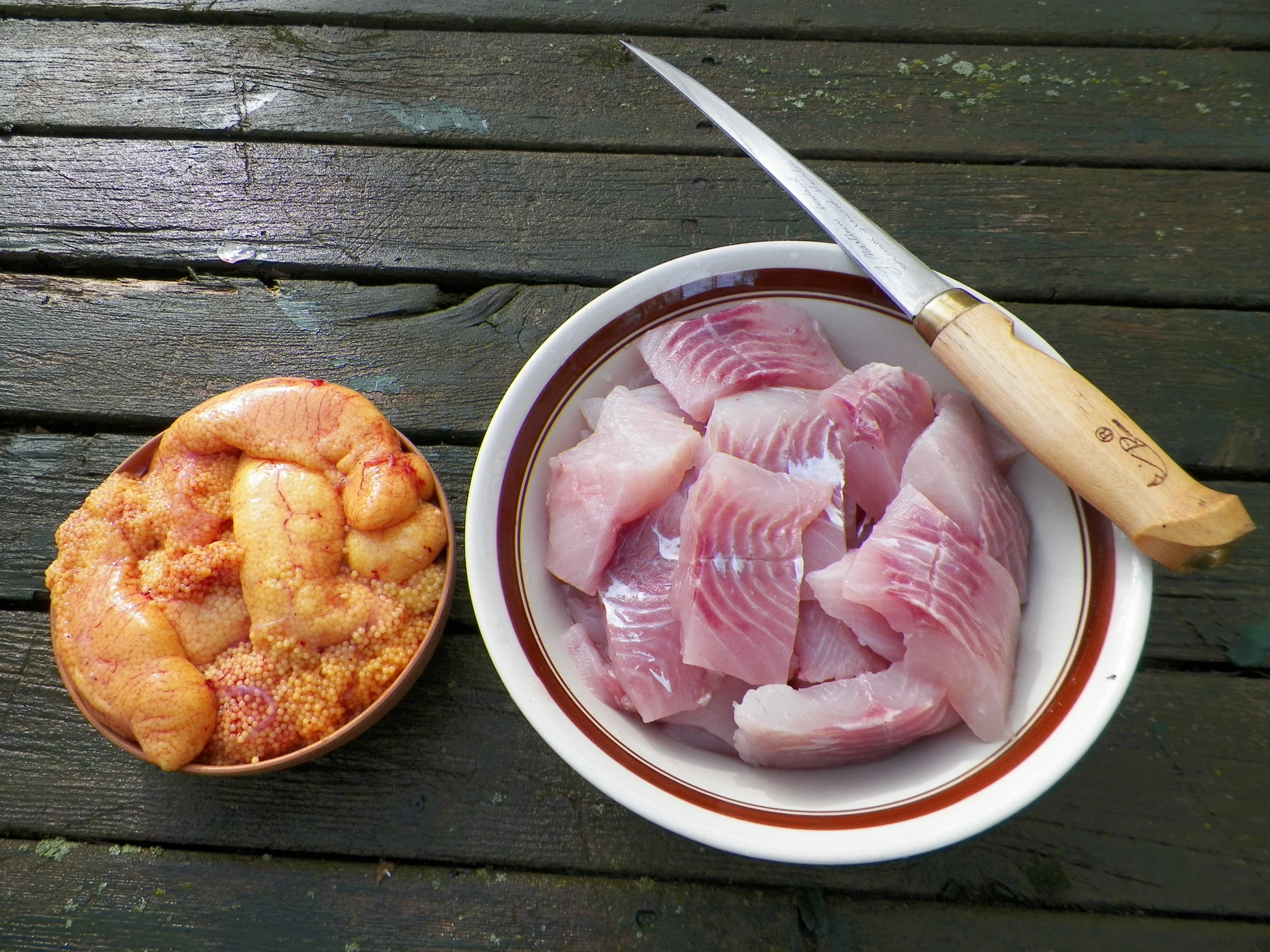
The recipe for pickled suckers is simple, and is basically the same recipe I use for any number of fish species, such as small northerns or bullheads. I don't pickle a lot of fish, because I much prefer my fish pan fried, baked, or broiled in foil over a campfire, but it is nice to have a few jars of pickled fish around for when the mood hits or when we just want a quick snack to go with a cold beer on a summer evening.
Ingredients:
- Kosher salt
- 2 cups distilled white vinegar
- 1 cup white wine (I used some of our apple wine)
- 1 cup brown sugar
- couple tablespoons of pickling spice
- sliced onion and a few small Thai or chili peppers
After cutting your fillets into chunks a couple inches wide let them soak in a brine solution of water and kosher salt (I use around 1/4 cup of salt for 4-5 cups water, but I admit I'm not real fastidious about measuring...it's more of an eye-balling and taste thing...). Let the fillet chunks soak for 1 to 3 days. I let these soak for only one day. Some folks say let your fish soak in the brine for 5 days, but I've never done that.
After they're finished brining, rinse them THOROUGHLY in cold running water for several minutes. Let them sit in cold water for several more minutes and then rinse them again. They should be pretty well saturated with the salt brine, which hardens them up quite a bit, but you don't want them to taste too salty, so a good, extended rinsing is in order.
While you're rinsing the fish boil the vinegar, wine, spice, peppers and brown sugar for a few minutes until everything dissolves (keep stirring it as it boils). Pack some sterilized canning jars with the fish chunks and onions, and pour the pickling brine over the top. Use a butter knife at the inside of the jar to allow pickling brine and spices to flow into the entire jar and remove some of the air pockets. Wipe the rims, put the lids on and screw on the bands. Date the lids and set the jars in your fridge for a few days to let the fish and pickling brine get better acquainted.

For this particular batch of roe I made a less salty brine and soaked the eggs in that for a few minutes, packed them into a jar along with a few sliced onion halves and then added the pickling juice (strained to remove the spices) to fill. These won't last long as I'll probably have them for breakfast over the coming week, mixed in with omelets or scrambled eggs.

Sucker roe with onions.
For anyone wondering, sucker roe is much more mild than the salmon roe I cured a couple months ago. It has a very subtle, gentle flavor.

Dad with a couple of large suckers.
more ramps - pizzas
It probably goes without saying that during ramp season we use them in a lot of our cooking. Basically anywhere we might normally use onions, leeks or shallots as ingredients, and then in a few things that feature ramps specifically.

Many of the ramps we harvested this week boasted really beautiful, large bulbs, some as large as my thumb.
Had some of the crew over last night to welcome our friend Pat back from his short vacation. We made pizzas, had some wine and beer, and hung out around the fire for a while. The pizzas all featured ramps that I harvested the day before.

I made three different pizzas, but each was highlighted with diced ramp bulbs and leaves. In the image above, from left to right, we have almost-ready for the oven: 1) tomatoes, ramps and cheddar cheese, 2) roasted red peppers, pickled artichokes, kalamata olives, ramps, 3) sliced baby red potatoes, mushrooms, ramps (I added mozzarella cheese to the final two pizzas after taking the picture).
Ducks get a little more yard area
This morning I put up a make-shift swimming pool and plastic netting enclosure for the ducks to use, just outside of their coop. They make such a wicked sloppy mess of their bedding in the area around their water bucket that I figured it might be better to have the watering area outside of the coop, at least during the warmer months. Next week I'll put together something more solid and attractive, but today I was in the mood and just used what materials we had on hand, including emptying out a big red tote that usually holds all of our Christmas decorations but now subs as a swimming pool.

We hope to put a fence all the way around the yard this summer so that the ducks can roam freely and safely in the yard and garden during the day. I still have some work to do on the coop, like finishing the roof off with some greenery, and I hope to finish that up this week as well.

We clipped their wings before setting them loose in the swimming area, although Kim's duck, Daphne, is so fat that I doubt she could fly without some assistance from a jet-pack.

We're getting two eggs a day from them now, which is pretty cool and has me thinking that a couple more layers might be worthwhile.