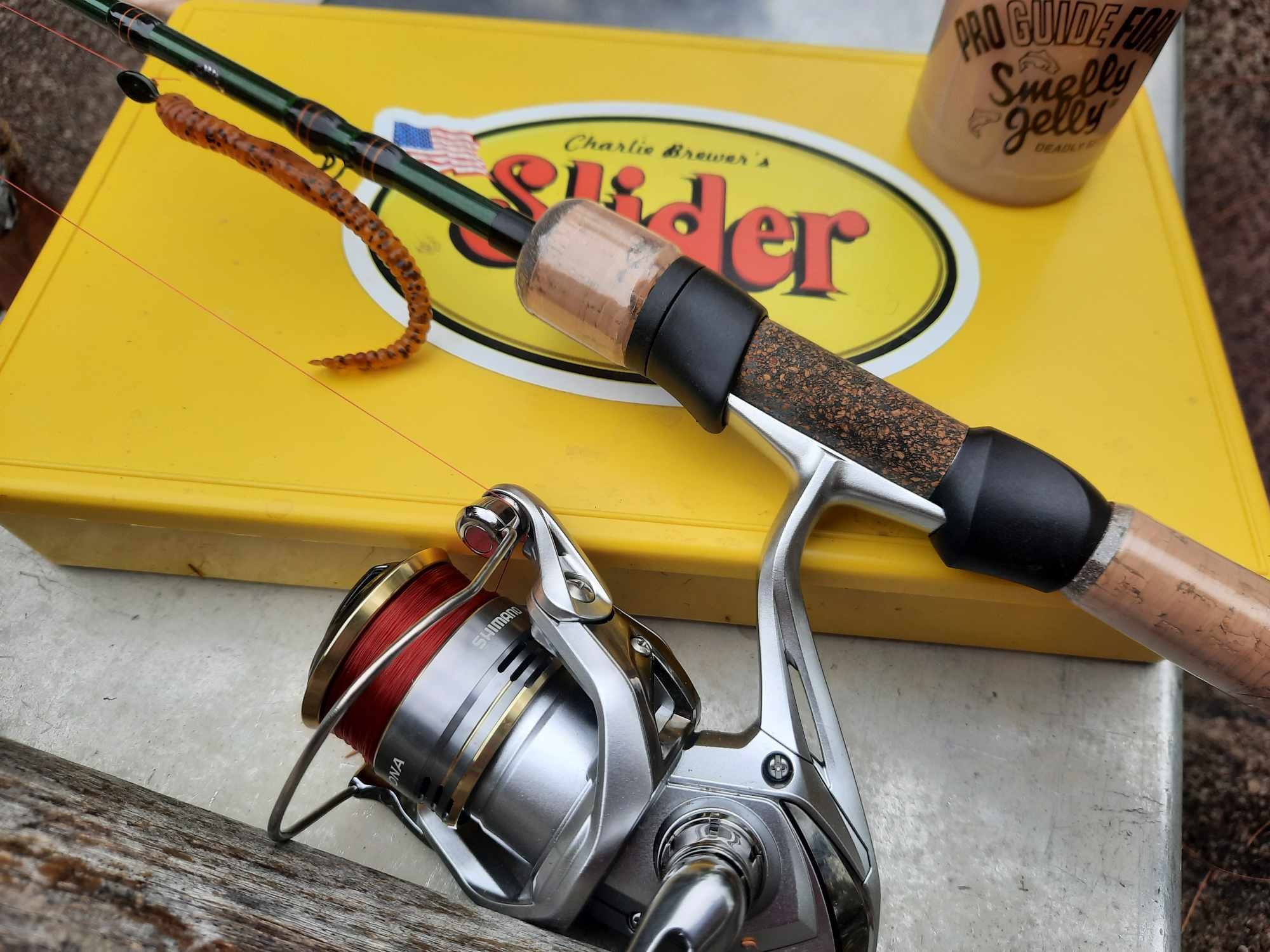
The History of Sportfishing

My friend Terry Battisti has been involved in an exciting project over the last couple years, titled “The History of Sportfishing.” Well, all 12 episodes are now out. Terry has written two 1-hour episodes of the 12. Readers of Bass Fishing Archives will know Terry as the creator and primary writer of that historical archive (it’s one of the places where you can also find my own writing on the subject). He’s also a co-host on the video channel Big Bass Podcast and a frequent guest on the Bass After Dark video show.
The group of individuals who have produced and created The History of Sportfishing is second to none, with a solid track record of award-winning series for television and theater. But you can read all about them and the documentary film series at the History of Sportfishing website, as well as subscribing to or purchasing the series.

Here’s are a couple video snippets from the History of Sportfishing YouTube channel:
I encourage everyone to go the project website and YouTube channel, watch the video snippets, and think about purchasing either individual episodes or subscribing to the entire season. If you love fishing, you’re sure to love this series.
2024 Antique & Classic Outboard Motor Club Tomahawk National Show
Yesterday I drove up to Tomahawk, Wisconsin and attended the Antique Outboard Motor Club National Show. I saw several beautiful vintage boat and motor displays, and visited all of the booths of vendors selling old outboards, parts, manuals and other paraphernalia. I just love the look of old wood boats and outboard motors. The craftsmanship that went into these objects is unparalleled.
I picked up a couple of old manuals, a 1927 Hunting & Fishing magazine (full of awesome old fishing and hunting ads), a tee-shirt and a hose for my 1956 Mercury outboard. Next year I’m thinking I might buy another old motor or two. Here are a few photos from the show.




Sea to Summit Camping Cook Pots
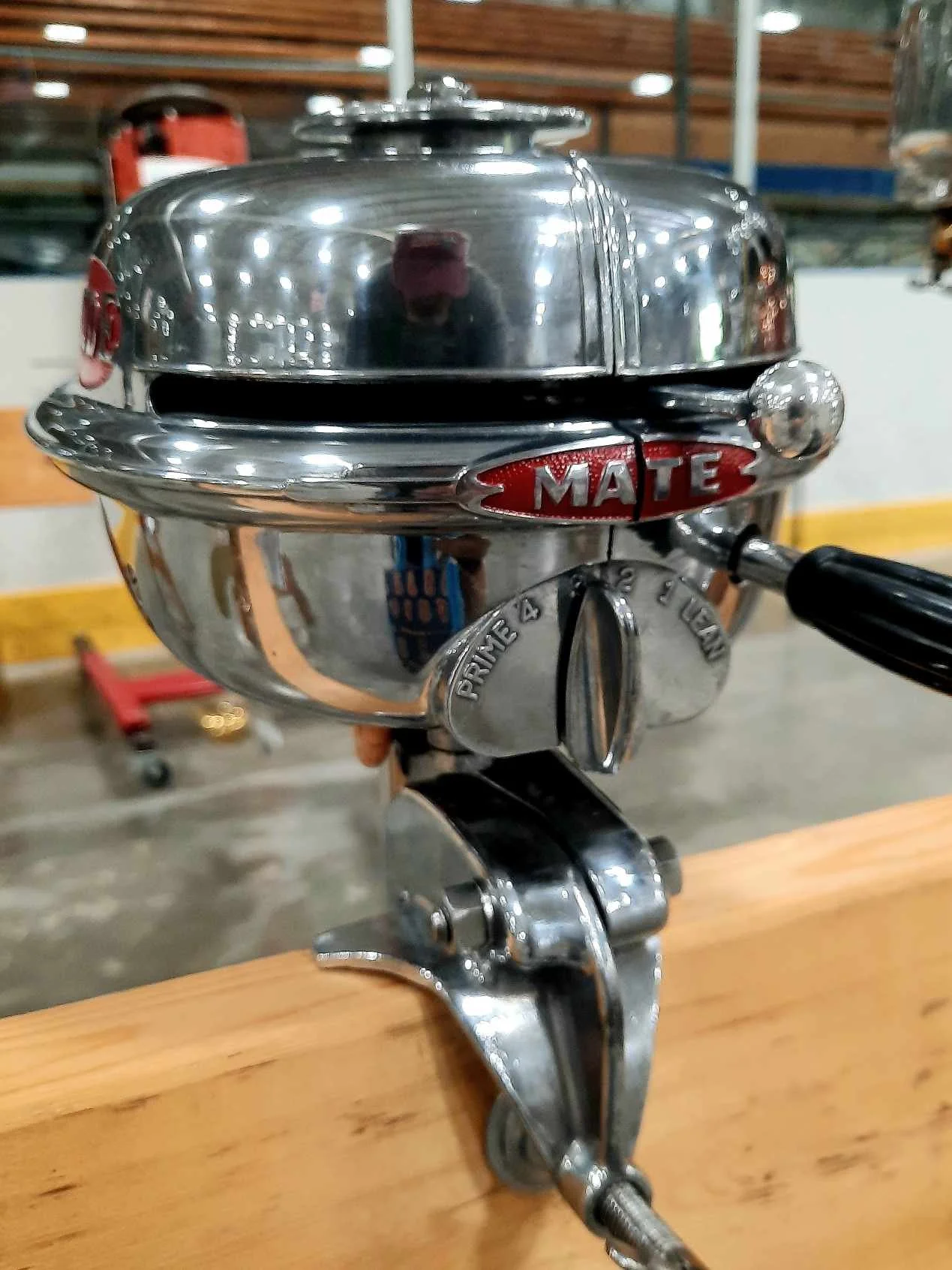
Sea to Summit has hit a home run with at least two of their Camp Kitchen line of cooking pots. The Frontier UltraLight Pot 1.3L size, and the Detour Collapsible Pouring Pot 1.8L size. I gave these pots a good workout, cooking several meals or dishes while camping, where they performed very well. But my enthusiasm for them is bolstered by the fact that I continue to use them at home, especially the Frontier UltraLight Pot. That little kettle has become my favorite all around cooking pot, both when out in the field and at home on the stovetop.
First, the Detour Collapsible Pouring Pot. The clever feature of this pot is that it collapses to less than half its full size, thanks to a rubber center gasket that folds in on itself when the pot is not in use. It works like those collapsible plastic travel cups you probably saw when you were a kid. This is fantastic for camping storage, and Sea to Summit has wisely made full use of this technology by producing more full cooking and dining sets that are collapsible. I plan on changing out most of my camping kitchen gear to these sets. Just thinking of the space I’ll save when packing makes me smile.

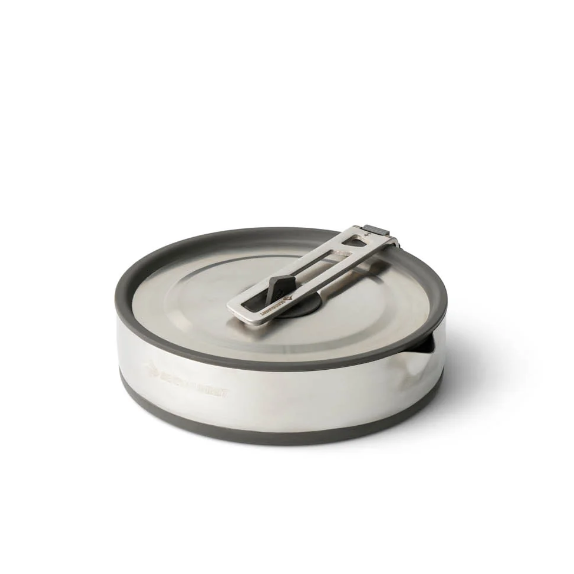
But the Detour Pot has more to recommend it than just its compactness. The handle is another big benefit. The handle can be used as a regular pot handle, and then once you’ve finished cooking and are ready to store the pot, the handle can be reversed, locked into place and will securely hold the pot lid in place. They call it a Dual Click-Safe handle. Darn clever. I had no worries about carrying a full pot of soup with the handle locked in place.
The metal portions of the pot are stainless steel, which means that it’s durable and easy to clean. The rubber collapsible gasket is BPA-free and food safe. Honestly, I had my doubts about this pot. The collapsible rubber side in the center of the pot had me wondering how it would take the heat of a camp stove, but cooking was as straightforward as with any other pot, and cleaning up was just as easy. But what I really like is the compact stowaway benefit.

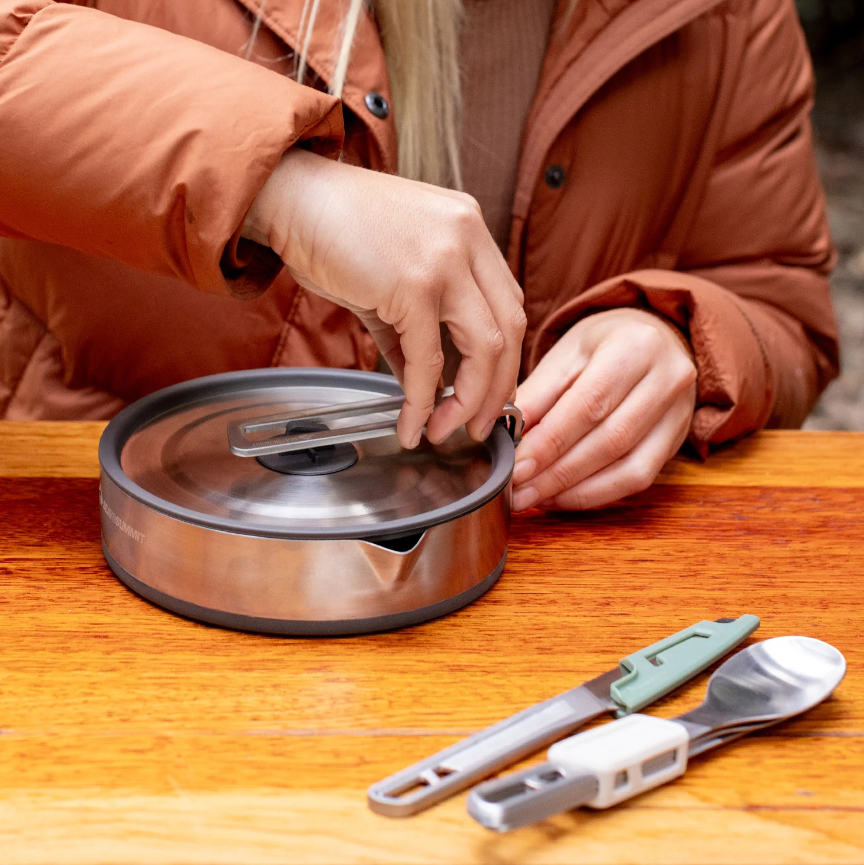
Next, the Frontier UltraLight Pot. This has become my favorite in-home pot. Sure, it performed quite nicely while camping, but I found it to be so serviceable and convenient that I continue to use it in my home kitchen. The 1.3L size is perfect for one person, but Sea to Summit also makes a 2L and 3L size with the exact same features. The 3L pot is on my personal Christmas wish list.
This is a light-weight anodized aluminum alloy pot with a ceramic non-stick coating that makes for easy clean-up. The Dual Click-Safe handle functions the same as in the Detour Pot, and secures the lid when you’re not using it. I store some small items in the pot itself when camping, and the lid stays tight because of the handle. The inside of the pot has measurements so you can be precise when adding water or broth to a dish, but frankly I never paid any attention to those. 1.3L is a small pot and I had no need for internal measurements. But if I get the 3L pot those might come in handy.


What really sold me on this light-weight little pot, however, are the strainer holes in the lid. Man, that is a great feature. If I’m cooking pasta, boiling eggs, or any other liquid dish where the liquid needs to be drained after cooking, this feature is well appreciated.
My only complaint is that the top, silicone lid handle could be just a bit larger on both pots. My fat fingers could have used another half inch of handle to grab onto.
Overall, these Sea to Summit cook pots are impressive, and are a welcome addition to my camping kitchen kit (and my home kitchen). Good job, Sea to Summit.


How to Sniff Out the 'Knife Crazy' Person in Your Life
Do you know someone who is a bit obsessed with knives? Here's a case study of that knife-crazy person in your life.
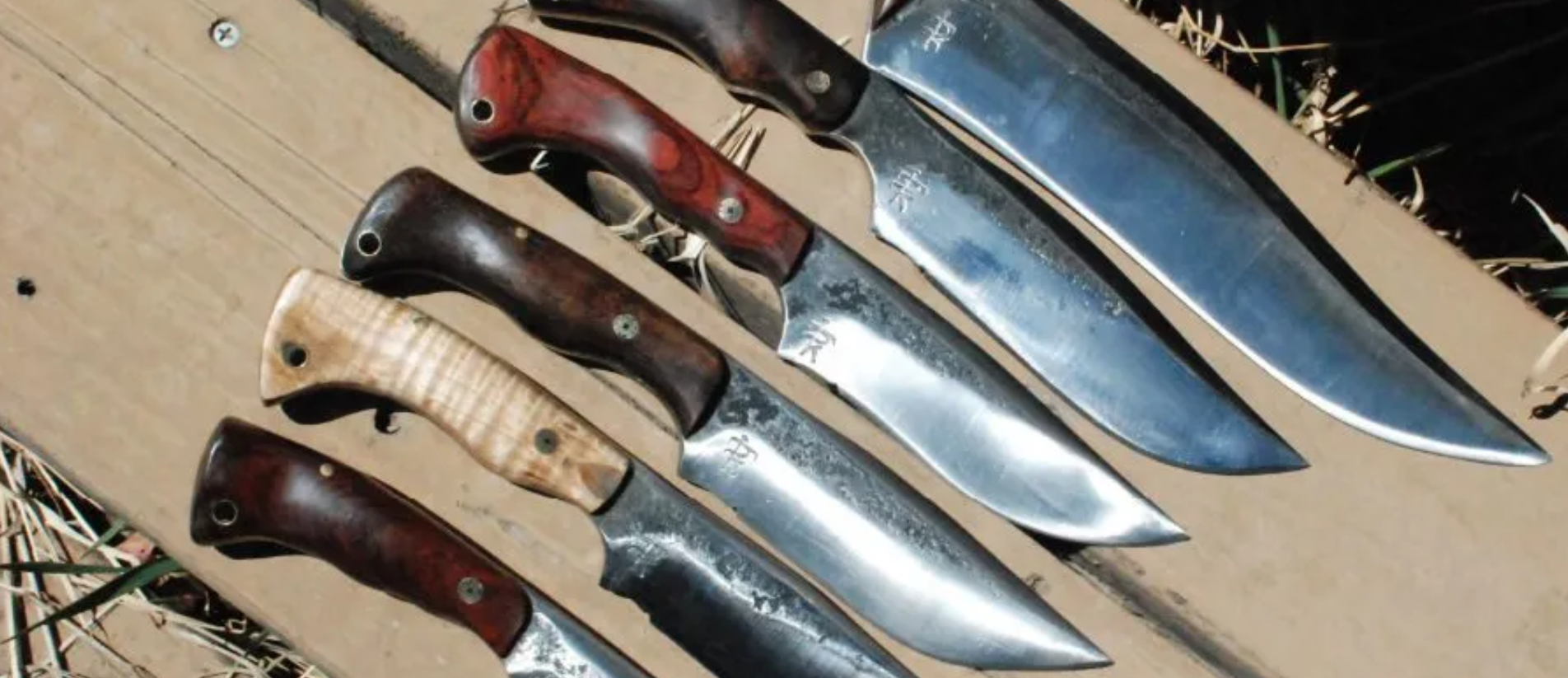
I’m guessing that a lot of us have at least one knife-crazy person in our family or list of friends. Shoot, you might even be a knife-crazy person yourself. There's no shame in being enamored or even obsessed with edged weapons. There are many other things that folks fixate on and collect that could arguably be worse.
But I do find these folks interesting and their obsession oddly compelling. You see, I have some intimate knowledge of this kind of person. My brother is that knife-crazy person, or as I like to say, a crazy knife person.
Let's face it, these folks can be a little irritating. That's the case with my brother, at least. There's even a word for their affliction. It's called aichmomania, which is an obsession with sharp, pointy things such as knives. My brother would undoubtedly be considered an aichmomaniac. I'm not sure he likes being called one, but that doesn't stop me.
But seriously, there are a few traits that describe the aichmomaniac fairly well. First, they always seem to have a small duffel bag full of knives with them. Whenever my brother comes over for a visit, he's inevitably carrying a small duffel bag. He either sets the bag dramatically on the table as though he's about to unveil something mysterious, or he subtly sets it off to the side, in which case I know he's got some "old" knives that have either been newly sharpened or have new sheaths. It just depends on how quickly he wants to get to the knife demonstration.
Whether it's a new knife or an old one that's been modified, he always has something to show me.
If he has a new one, he's sure to fill me in on every single piece of information regarding its construction. He can go on and on about the most specific details. But even though I tend to glaze over at times, it is interesting. He looks at knives much like I look at different types of fishing line or .308 loads.
Next, he's able to discuss both the pros and cons of different knife sheaths, whether they're kydex, leather or a combination of the two. This is where I perk up a bit. I love a good sheath, and can appreciate both the aesthetic and practical qualities that go into one. I love the combination of form-fitting kydex covered in tooled brown leather.

Source: Peter Kohler - Dark Timber Brotherhood
Next, he performs the paper-cutting demonstration, usually by grabbing whatever paper happens to be within reach. More than likely, it's one of my bills, tax forms or something else important to me. Before I can protest, he'll neatly and slickly slice it into ribbons with a knife he's sharpened to a razor's edge, as if to validate everything he's said up to that point.
"Just look at this baby," he'll say. "Like butter, man, like butter!"
Finally, he'll allow (force) me to hold the knife and, if it's a folder, nag me to open it with one hand in one quick, smooth motion.
"Flick it like you mean it!"
If it's a fixed-blade knife, he demands that I move my hand around on the handle.
"How's that feel?" he'll ask. "Choke up on it and put your thumb on the jimping. Feel the weight and heft of it. You can see how this one would be good for batoning."
"Yes, yes. It would be great for batoning or whittling feather sticks," I'll say, trying to impress him with my experience.
This is the routine we'll go through with every knife in his bag, of which there are usually four or five, including at least one new one.

My brother, the knife-crazy…or crazy knife person.
Of course, my brother has his favorite makers, for both production and custom knives. Peter Kohler's Dark Timber knives are his current favorite, which I'd have to admit I'm quite impressed with myself. You can't help but fall in love with Kohler's beautiful, hand-forged blades.
Finally, you can also identify that knife-crazy person by their Instagram page. Where most folks will display photos of their kids, travels or fishing pics, your knife aficionado will have his page peppered with images of blades. If you know someone who displays any of these traits, there's a good chance they're a legitimate aichmomaniac.
If I'm not careful, I might be headed that way myself. There are worse things a guy could be.
Creative Sustenance to Stumpjack Outdoors
I’ve begun updating this website/blogsite again in recent months. Creative Sustenance began as a purely foraging/hunting/fishing/cooking blog and image site, with an emphasis on the foraging and cooking. Over the last few years I’ve become more interested in vintage fishing (collecting and using old lures and tackle), as well as expanding this and other platforms to include those interests.
I also get contacted regularly to review outdoors-related products, which I enjoy doing. But I don’t publish my opinions on everything that comes my way because, frankly, some of it doesn’t merit a positive review. And since I don’t get paid to review things (other than receiving the product, which I suppose is some form of compensation) I feel no obligation to any company one way or the other. So, if I do publish a review and share it on my Stumpjack Outdoors Facebook page (50k followers as of this date) you can be sure it’s a product I like and am happy to give a thumbs up to.
We’ve also moved to northern Wisconsin again, which has opened up more outdoors-related opportunities for my wife and I. All of this is to say that Creative Sustenance is changing, changing focus a bit to include other interests like vintage fishing, fishing lure making, leather work, photography and video production. I’ll be changing the name of the site from Creative Sustenance to Stumpjack Outdoors, to connect it thematically to my Facebook page, Instagram account and Youtube channel, all of which are named Stumpjack Outdoors.
So, thanks for following. And please check out my other Stumpjack Outdoors platforms:
* Stumpjack Outdoors facebook page.
* Stumpjack Outdoors instagram account.
* Stumpjack Outdoors youtube channel.


'The Greatest Gun Designer in the World' - The Remington Model 12 and John D. Pedersen
The beautiful plinker and small-game rifle was engineered by a man John Browning deemed the best to ever design a gun.
"Long time ago, when I was 11 years old, there used to be a park in Kansas City called Fairyland Park," one person recalled on a shooting forum. "It had a wood roller coaster and all the other rides. Tucked into one corner was a shooting gallery.”
"The guns were Winchester pump .22s cabled to the counter, and for, I think, 25 cents you would be given a rifle with 15 .22 Shorts to shoot at all the moving targets. You even reloaded them yourself. They had the ducks, the pipes, the stars, the cowboys, everything you've ever seen in movies and old cartoons. It was the most fun I ever had."
It would be fair to say that the success of the Winchester Model 1890 directly influenced the development of the Remington Model 12.
Eager to get a piece of the sales that the 1890 was earning—almost 850,000 units sold from 1890 to 1941—Remington enlisted the aid of John Douglas Pedersen to design a similar pump-action rimfire rifle.
Pedersen and the military
Pederson was a gun-designing contemporary of famed firearm designer John Browning. But Browning mistakenly thought Pedersen would be better remembered than himself.
In fact, Browning told U.S. Army Major General and noted firearms expert Julian S. Hatcher that Pedersen "was the greatest gun designer in the world." Browning's assessment of Pedersen may have turned out to be true had fate not intervened to deal Pedersen some serious spotlight-stealing blows.

John D. Pedersen
However, Pedersen is remembered for a few highly noteworthy firearms innovations and designs. His attempts to gain military contracts for his gun designs were marred mostly by bad timing and bad luck.
For example, his .45 pistol design was approved by the U.S. Navy but it ultimately lost out to the M1911 pistol already being manufactured for the Army. His semi-auto rifle design also lost out to the now iconic Garand rifle.
His Pedersen Device was perhaps his most ambitious design and could have made a significant impact during WWI. It was an invention attached to a M1903 Springfield bolt-action rifle that allowed the rifle to operate as a semi-automatic. Unfortunately for Pedersen, the device was approved for production just as the war was ending.
But as something of a moral victory, General George S. Patton owned one of Pedersen's pistols, the Remington Model 51. Patton was thought to have favored the pistol as his personal sidearm and it can be seen in many photographs of the General.
Pedersen also attempted to mass produce M1 carbines for the military during WWII, via his own company, the Irwin-Pedersen Arms Company, but that endeavor also failed.
Civilian market
Pedersen actually collaborated with Browning, when Browning made the principle design for the Remington Model 17 pump-action shotgun. Pedersen altered Browning's design before production by the Remington Arms Company in 1921. The 20-gauge shotgun featured a tubular magazine, bottom-loading and bottom-ejecting portals, and it was hammerless. The Model 17 later became the Remington Model 31, Ithaca 37 and Browning BPS, all very successful shotguns in the civilian market.
Pedersen either designed directly or had a hand in just about every firearm that Remington produced from 1903 to 1940. He was prolific, earning at least 69 patents for his firearms designs. These included the Model 12, 14, and 25 pump-action rifles, and the Model 10 pump-action shotgun.
It could also be fairly said that Pedersen had an indirect hand in the design of the famous Remington 870 pump-action shotgun, in that several of his design elements are present in that famous gun.

Remington Model 12
Pedersen died of a heart attack in 1951 while traveling through Cottonwood, Arizona. He was 70 years old.
Over the course of his career, Pedersen designed many firearms that were popular with hunters and shooting enthusiasts. His designs were lauded for their workmanship and efficiency, although they were sometimes criticized for being more mechanically complicated than they needed to be. Today, his guns are highly regarded by collectors and shooters.
The Model 12 Remington
While the Model 12 design was undoubtedly influenced by the Winchester 1890, Pedersen engineered it to have a much sleeker, less clunky appearance. It's a trim, more modern-looking long rifle than the 1890, but with enough antique features that make it beautifully distinctive compared to today's rimfire rifles.

Winchester Model 1890

Remington Model 12
For one thing, the Model 12 dispenses with the exposed hammer of the 1890. Featuring an internal-hammer receiver, the rifle looks sleek and efficient. This profile undoubtedly appealed to shooters, and Winchester eventually began producing pump-action rimfire rifles replicating the internal-hammer design.
The Winchester Model 61 .22 WRF was released in 1932 and appears to be, with a few notable exceptions, almost a carbon copy of Remington's Model 12.

Remington Model 12 (top)
Winchester Model 61 (bottom)
Another identifying component of the rifle is the unique teardrop-shaped ejection port on the right side of the receiver. Chambered for .22 Short and .22 LR, the cartridges are loaded in an under-barrel magazine tube.
Interestingly, the forestock is attached directly to the magazine tube, unlike in other slide-action guns where the magazine remains stationary and separate from the forestock.


Both the Model 12 and the 1890 have a straight grip stock, but the comb on the 1890 is less pronounced on the model 12. The metal butt plate is also gently concave, lending a cool, old-timey appearance to the gun.
But the feature I love the most on this Remington rifle is its octagon barrel. Nothing says vintage long gun to me quite like an octagon barrel.
The safety is located at the right rear of the trigger guard. There is also a small button at the top inside of the trigger guard that can be depressed to release the pump should it become locked in place.
The rifle can be broken down into two parts by removing a screw knob on the left side of the receiver, for ease of transporting or cleaning.


Remington issued a number of variations—Model 12A, Model 12B, Model 12C and so on—that differed in barrel length and ammunition caliber variations, had round barrels and pistol grip stocks, as well as a few customizable features. As you went up in the alphabet—model 12D, 12E and 12F—you could special order one of the pump rifles with higher quality wood, gold or silver inlays and deluxe embellishments, such as special front and rear sights.
I've looked at several lists of the various models and their corresponding features and none of those lists exactly matches the others, so until I can find an actual record from the Remington Arms Company specifically outlining what each variation entailed, I can't say for sure what exactly is what.
I’m pretty sure my rifle is either a 12A, 12B or 12C, probably a Remington 12A standard model, although there's some uncertainty regarding that. According to its serial number, I believe it was manufactured in 1913.

Remington Model 12 (top)
Winchester Model 61 (bottom)